

Details
Read time
5 Minutes
Date
July 27, 2026
Punta Rata Beach: The Complete Guide to Visiting Brela
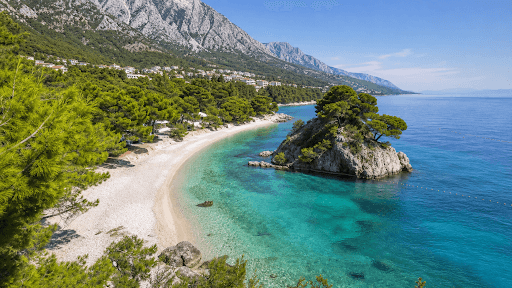
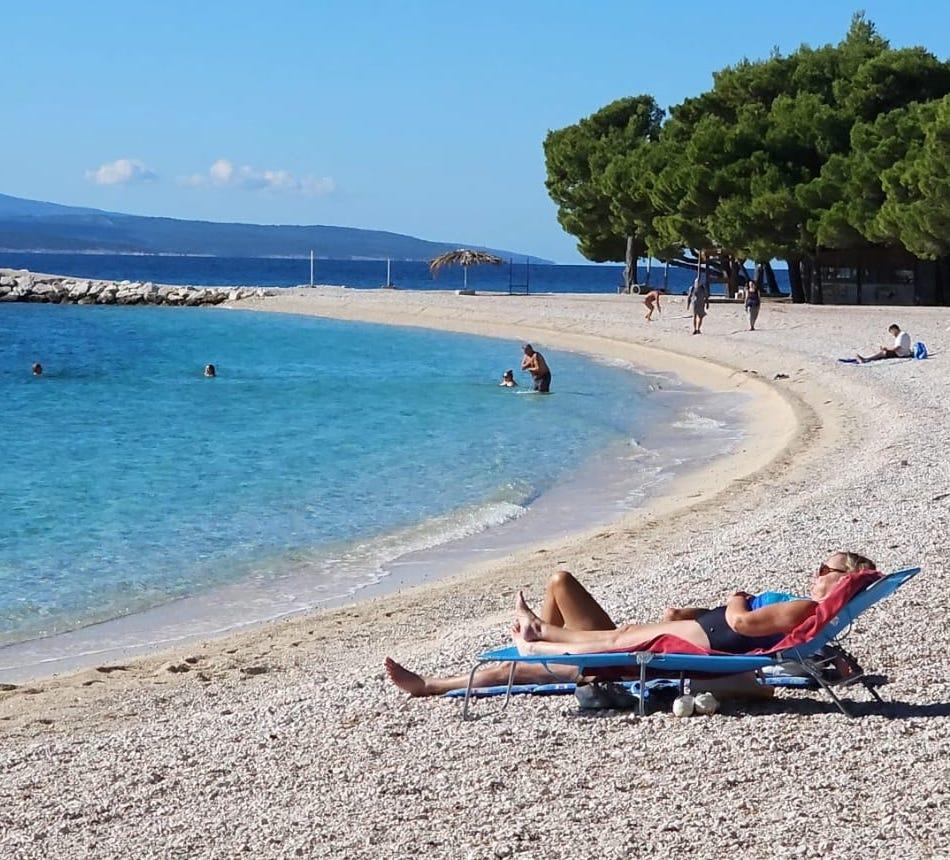
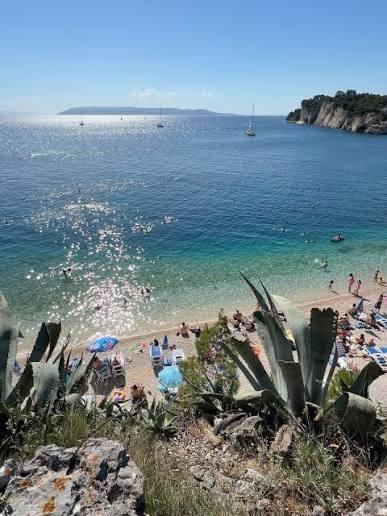
Punta Rata Beach is the place many travelers picture when they imagine the Croatian coast: pale pebbles, transparent blue water, pine trees leaning toward the sea, and the steep Biokovo mountain rising behind the shoreline. The beach sits in Brela on the Makarska Riviera, but its atmosphere is very different from a large resort strip. It feels green, walkable, and naturally sheltered, with small coves connected by a waterfront promenade.
The famous photographs are only part of the appeal. Punta Rata also works as a practical swimming beach. There is natural shade, the sea is usually clear enough to see the pebbled bottom, and cafés, showers, toilets, rentals, and other visitor facilities are close at hand. Families can spend a full day here without complicated logistics, while couples and solo travelers can use it as the starting point for a longer coastal walk through Brela.
This guide covers everything needed to plan the visit, from parking and water shoes to the best time for photographs, nearby beaches, activities, accommodation, and realistic expectations in July and August.
Punta Rata Beach at a Glance
- Location: Brela, on the Makarska Riviera in Central Dalmatia
- Beach type: Fine, smooth pebbles rather than sand
- Best for: Swimming, families, couples, photography, coastal walks, and relaxed beach days
- Natural shade: Excellent in many sections because pine trees grow close to the shore
- Water entry: Generally comfortable, although the depth and pebble slope vary along the beach
- Facilities: Showers, toilets, cafés, food options, loungers, parasols, and seasonal water-sport rentals
- Parking: Limited and expensive in peak season; the official visitor information currently lists parking toward Punta Rata at €4 per hour
- Best arrival time in summer: Before 9:00 a.m. for easier parking and a better choice of beach space
- Best months for balance: June and September
- Signature sight: Kamen Brela, or the Brela Stone, a pine-covered rock just offshore
- Recommended footwear: Water shoes or secure sandals
- Ideal visit length: Half a day at minimum, or a full day if combining swimming with the Brela promenade
Where Is Punta Rata Beach?
Punta Rata is in the coastal town of Brela, about 15 kilometers northwest of Makarska. Brela stretches along the lower slopes of Biokovo, so the town is long, narrow, and steep rather than arranged around a flat center. The beach occupies a protected, pine-covered section of coast west of the Soline area.
The setting explains much of Punta Rata’s character. Biokovo rises sharply behind the town, while the coast faces the Adriatic and the island of Brač. Houses and hotels sit above the water, connected to the shore by sloping lanes and steps. At sea level, a pedestrian promenade links Punta Rata with neighboring beaches and coves.
Brela’s geography is beautiful, but it affects planning. A property that looks close to the beach on a map may be considerably higher than the shoreline. A walk of only a few hundred meters can include a steep return climb. When choosing accommodation, check elevation and the walking route, not just straight-line distance.
Why Punta Rata Is One of Croatia’s Most Recognizable Beaches
Punta Rata became internationally known because it combines several features that rarely appear together so neatly. The water is intensely clear, the pebbles are pale, mature Aleppo pines provide shade, and the Biokovo mountain creates a dramatic background. The coast feels landscaped, but much of its visual power comes from protected natural vegetation.
The beach is also closely associated with Kamen Brela. This small rock formation rises from shallow water near the western end of Punta Rata. Several pine trees grow directly from it, creating one of the best-known images of the Makarska Riviera. The rock appears on postcards, tourism campaigns, and the local municipal coat of arms.
Recognition has brought crowds, particularly during the central summer weeks. Punta Rata is not a hidden beach, and arriving at midday in August will not feel secluded. Its lasting strength is that the setting remains impressive even when the beach is busy. Visitors who arrive early, stay into the evening, or travel outside the peak months experience a much calmer version of the same coastline.
What the Beach Is Really Like
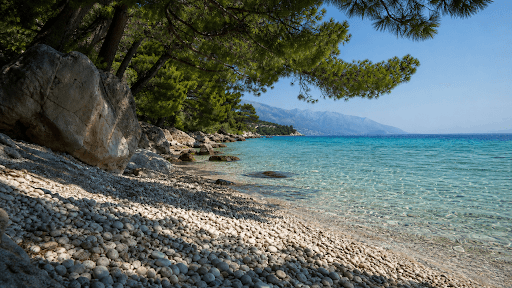
Pebbles and shoreline
Punta Rata is a pebble beach. The stones are generally small, rounded, and lighter in color than the coarse gravel found on some Croatian shores. They are attractive and relatively comfortable by Adriatic standards, but they still become hot in direct sun and can be tiring under bare feet.
Water shoes make the experience easier. They help when walking across heated pebbles, entering the sea, and moving around rockier edges near the coves. Secure sandals are useful on the promenade, but shoes designed for the water are better for swimming.
The shoreline is not completely uniform. Some sections have a gentle entry that suits children and cautious swimmers. Other points deepen more quickly. Families should choose a position after looking at the water entry rather than assuming every part of the beach has the same slope.
Water clarity and swimming conditions
On calm days, the water around Punta Rata can be exceptionally transparent. Swimmers can often see the pebbled bottom clearly, even after moving away from shore. The lack of sand helps preserve visibility because footsteps and small waves do not create clouds of sediment.
Morning conditions are often the calmest. A light northwesterly summer breeze may develop later in the day, adding texture to the surface and providing relief from the heat. Larger waves are possible when weather systems move through, so the sea should never be treated as completely predictable.
The marked swimming area helps separate swimmers from boats and powered water activities. Children still need close supervision. Clear water can make depth difficult to judge, and the seabed may fall away faster in some sections than it appears from the shore.
Pine shade
Natural shade is one of Punta Rata’s biggest practical advantages. Mature pines grow close to the beach, especially behind the central and western sections. The canopy offers relief during the hottest part of the day and makes a full-day visit more comfortable than it would be on an exposed pebble shore.
Shade is not guaranteed. The best spaces are claimed early in July and August, and the position of the sun changes throughout the day. Branches, roots, and sloping ground can also make some shaded areas less comfortable for large towels or strollers. Visitors who need reliable cover should bring a sun shelter or budget for a parasol rather than depending entirely on the trees.
The Best Time to Visit Punta Rata Beach
May
May is quiet, green, and well suited to walking, photography, and relaxed lunches by the water. Warm days are common, but the sea may feel cool for long swims. Some seasonal rentals and beach businesses can operate on reduced schedules, particularly early in the month.
Choose May if the landscape and peaceful atmosphere matter more than guaranteed warm-water swimming.
June
June is one of the best months for Punta Rata. The days are long, the sea is becoming comfortable, and most visitor services are operating. The beach is lively without consistently reaching the density of late July and August.
The second half of June is warmer and busier than the beginning. Arriving early is still helpful, but parking and beach space are usually less stressful than during the main school-holiday period.
July and August
July and August deliver the warmest, most reliable beach weather and the fullest range of seasonal activities. They also bring the highest accommodation prices, heaviest traffic, limited parking, and the largest crowds.
The difference between 8:00 a.m. and noon can be dramatic. Early visitors can choose a shaded section, swim in calm water, and photograph the coast before it becomes crowded. By late morning, the most attractive sections may be tightly occupied.
If midday density becomes uncomfortable, use the promenade to explore a neighboring cove or take a longer lunch away from the busiest shoreline. Another good strategy is to arrive in the late afternoon and stay until sunset.
September
September is the strongest alternative to June. The sea retains much of its summer warmth, while family-holiday crowds begin to thin. Early September still feels fully summery. Later in the month, evenings become cooler and occasional unsettled days are more likely.
For adults who can travel outside school holidays, September offers one of the best combinations of swimming conditions, space, and value.
October and the cooler months
October can produce beautiful walking and swimming days, particularly early in the month, but conditions are less predictable. Many seasonal beach services reduce their hours or close. Winter and early spring are better for coastal walks, photography, and experiencing Brela without resort-season activity.
What Time of Day Is Best?
The best time depends on the goal of the visit.
- For calm water and empty photographs: Arrive shortly after sunrise or by 8:00 a.m.
- For families seeking shade: Arrive before 9:00 a.m. in July and August
- For warm swimming: Late morning through late afternoon
- For a quieter peak-season visit: Arrive after 4:00 p.m.
- For Brela Stone photographs: Use early morning for clean light and fewer people, or late afternoon for warmer color
- For sunset atmosphere: Stay on the promenade and western side of the beach into the evening
An early start offers the best all-round experience. The air is cooler, the promenade is peaceful, and the first swim often feels like the clearest and calmest of the day.
How to Get to Punta Rata Beach
From Split Airport
Split Airport is the main international gateway for Brela. The drive normally follows the coast and takes roughly 75 to 100 minutes, depending heavily on traffic. Summer congestion around Split, Omiš, and the coastal road can extend the journey.
A private transfer is the simplest option for travelers carrying beach equipment or luggage. Renting a car provides more freedom for exploring the Makarska Riviera and Biokovo, but the vehicle may be inconvenient once in Brela because parking is limited and the waterfront is best explored on foot.
Public transport usually involves reaching Split’s main bus station and taking a southbound intercity bus toward Brela or Makarska. Not every service stops at the same point, and the bus stop may be high above the shoreline. Confirm the stop and the final walking route before travel.
From Makarska
Makarska is about 15 kilometers southeast of Brela. By car or taxi, the trip commonly takes 20 to 30 minutes outside heavy traffic. Buses on the coastal route can be practical, but the same elevation warning applies. The main road is above much of Brela, and reaching Punta Rata may involve a steep descent.
Travelers staying in Makarska should consider a taxi for an early arrival. It removes the parking problem and makes a sunset visit easier because there is no need to return to a distant car park.
By car from elsewhere in Croatia
Drivers usually approach Brela from the Adriatic coastal road. The route is scenic but can be slow in summer. Narrow local streets and steep access roads make the final kilometer more demanding than the main drive.
Do not rely only on the straight-line position shown by a map pin. Follow signed access toward the Soline and Punta Rata areas, and avoid turning into narrow residential lanes unless the route is clearly intended for through traffic.
Parking at Punta Rata
Parking is the most common source of frustration. Brela has limited space between the mountain and the sea, and demand is intense in July and August. Official visitor information currently lists the public parking area toward Punta Rata at €4 per hour. Prices and operating arrangements can change, so check the current local information before relying on a full-day budget.
The best approach is simple:
- Arrive before 9:00 a.m. in peak season
- Keep a payment card and some cash available
- Photograph the parking rules and closing time
- Do not leave valuables visible in the car
- Expect a downhill walk to the beach and an uphill return
- Consider a taxi if staying within the Makarska Riviera
Parking farther away can reduce the hourly cost, but it may add a steep walk in strong heat. For families with toddlers, older visitors, or anyone carrying a cooler and beach equipment, the cheapest space is not always the most practical.
Can You Reach Punta Rata Without a Car?
Yes. In fact, visitors staying in central Brela often have a better experience without using a car. The waterfront promenade connects accommodation areas, beaches, cafés, and the small harbor. Once at sea level, walking is pleasant and largely separated from road traffic.
The difficult part is elevation. Accommodation above the coast may require stairs or a sustained climb. Ask the host or hotel for the exact walking route and number of steps. A taxi can solve the arrival and departure problem while leaving the rest of the stay car-free.
For a day trip from Split, Makarska, or another town, compare the total cost and inconvenience of bus connections, parking, and taxis. A shared private transfer can be good value for a small group, particularly if it enables an early arrival and a later return.
Facilities at Punta Rata Beach
Punta Rata combines a natural setting with the services expected at a major resort beach. Available facilities and seasonal businesses can vary, but visitors can generally expect:
- Public showers
- Toilets
- Rubbish bins
- Café bars and simple food options
- Sunbed and parasol rental
- Seasonal stands and small vendors
- Water-sport rentals and activities
- Marked swimming areas
- A paved or hard-surfaced coastal promenade
The facilities are distributed along the beach rather than concentrated in one large complex. Choose a position based on priorities. Families may want to be close to toilets and food, while couples seeking a quieter section can walk farther west toward the smaller coves.
Bring drinking water even when cafés are open. Summer heat, saltwater, and the climb back to accommodation make dehydration easy. A refillable bottle is more useful than relying on repeated small purchases.
Sunbeds, Parasols, and Beach Costs
Access to the beach itself is free. Spending depends on transport, parking, rentals, food, and activities.
Sunbeds and parasols are rented by seasonal operators, and prices can vary by location and month. Ask for the full-day price before settling in. If only staying for a few hours, bringing a padded beach mat may be more economical.
A realistic beach-day budget should account for:
- Parking or taxi fares
- Sunbed and parasol rental
- Drinks and lunch
- Ice cream or snacks
- Paddleboard, pedal boat, jet ski, or other activities
Visitors staying within walking distance can keep costs low by carrying water, fruit, and a beach mat. The clearest way to save money is to avoid paying for a full day of parking.
Swimming at Punta Rata
Punta Rata is excellent for recreational swimming. The water is clear, there are broad sections protected from boat traffic, and the view back toward pines and Biokovo is exceptional.
Less confident swimmers should enter from a gently sloping section and remain within the marked area. The sea can become choppier when the afternoon breeze builds. Inflatable toys and air mattresses can drift quickly, particularly if a breeze is blowing away from shore.
Swim parallel to the beach rather than directly toward open water if completing a longer workout. This keeps the route close to exit points and makes changing conditions easier to manage.
Snorkeling
The clear water makes Punta Rata a rewarding place for casual snorkeling. The central pebble sections are best for visibility and easy entry, while the edges of coves and rocky areas provide more structure for marine life.
Do not expect a tropical coral reef. The appeal is the visibility, shifting light, rock formations, small fish, and the transition between pebble seabed and rocky margins. Early morning usually gives the best combination of calm water and fewer swimmers.
Bring your own mask if snorkeling is important. Rental availability changes, and a familiar, well-fitting mask is more comfortable. Water shoes help when entering near rocks, but avoid standing on marine growth or disturbing animals.
Paddleboarding, Pedal Boats, and Water Sports
Seasonal activities are available around Punta Rata and the wider Brela waterfront. Depending on the operating schedule, visitors may find stand-up paddleboards, pedal boats, jet skis, parasailing, banana rides, and similar activities.
Stand-up paddleboarding is particularly appealing in the morning, when the surface is calmer and the temperature is lower. Stay outside marked swimming lanes only where permitted and follow the rental operator’s instructions.
Powered activities should be approached with more care. Confirm the price, duration, insurance terms, and designated operating area before paying. Families should check age, height, and supervision requirements for children.
Is Punta Rata Good for Families?
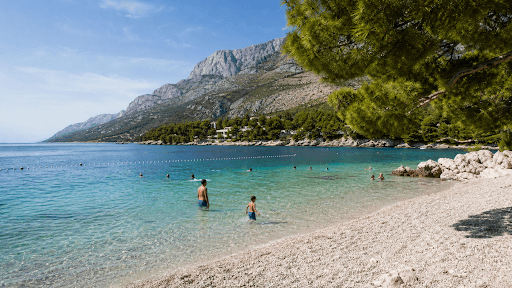
Yes, with a few practical qualifications. Natural shade, clear water, nearby toilets, and food options make Punta Rata easier for families than a remote cove. Some sections have a comfortable entry and enough shallow water for supervised play.
The challenges are pebbles, crowds, heat, and the steep terrain behind the beach. A stroller works on much of the promenade but may not help on stairs between accommodation and the waterfront. Lightweight equipment is preferable to a large beach wagon unless the exact access route is step-free.
Families should bring:
- Water shoes for children and adults
- High-protection sunscreen
- Hats and rash vests
- Drinking water and familiar snacks
- A padded mat or compact beach chairs
- A small first-aid kit
- A dry change of clothes
- Floatation aids appropriate to the child’s ability
Arrive early, inspect the water entry, and choose a position near the facilities the family will use most. Do not assume pine shade removes the need for sunscreen. Reflected light from the sea and pale pebbles remains strong.
Accessibility and Mobility Considerations
The sea-level promenade is one of Brela’s greatest strengths, but reaching it can be difficult for people with limited mobility. The town’s steep terrain means routes may include slopes, uneven surfaces, or stairs. Conditions differ significantly between access points.
Travelers who need step-free access should contact accommodation providers and the local tourist office before arrival. Ask precise questions:
- Is the route from the property to the promenade step-free?
- What is the gradient of the access road?
- Can a taxi stop close to the beach entrance?
- Are accessible toilets available nearby?
- Is there a firm route from the promenade to the preferred beach section?
The pebbled shore itself can be challenging for wheelchairs, walking aids, and unstable balance. A beach-access mat or assisted entry may be available seasonally, but it should be confirmed rather than assumed.
What to Pack for a Punta Rata Beach Day
The most useful item is a pair of water shoes. After that, pack for strong sun and a long stay rather than treating Punta Rata like a short urban-beach stop.
- Water shoes
- Reef-safe, high-protection sunscreen
- Hat and sunglasses
- Refillable water bottle
- Snorkel mask
- Microfiber towel or padded beach mat
- Waterproof phone pouch
- Light cover-up for cafés and the walk through town
- Small amount of cash plus a payment card
- Portable battery if using the phone for navigation and photographs
- Dry bag for electronics and valuables
Avoid carrying more than needed. The return walk may be uphill, and a heavy cooler that seems manageable in the morning can become uncomfortable in the afternoon heat.
Kamen Brela: The Famous Brela Stone
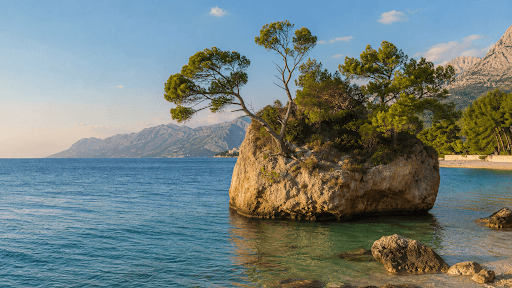
Kamen Brela sits near the western side of Punta Rata and is the coastline’s defining landmark. It is a breccia rock formation topped by hardy pine trees that have grown despite salt spray, exposed stone, and limited soil.
The rock is close enough to shore to feel part of the beach scene, yet separate enough to create a strong silhouette. It is especially photogenic when framed by clear water and the distant mountain slopes.
Treat it as a protected natural feature rather than a climbing prop. Photograph it from the shoreline, the shallows, or the promenade without damaging vegetation or blocking other visitors. The scene is often more attractive when people are included at a distance for scale rather than crowding the rock itself.
The Best Photography Spots
The western shoreline near Brela Stone
This is the classic postcard angle. Move along the shore until the rock separates visually from the background. Early morning gives cleaner water and fewer swimmers.
The promenade above the coves
Short raised sections of the coastal path provide a wider view of pines, pebbles, and changing water color. These positions work well for landscape photographs and video.
From the water
A waterproof camera or properly protected phone can capture the transparency of the sea and the mountain backdrop. Remain aware of swimmers and avoid drifting outside the designated area while composing a shot.
Late-afternoon light
The strongest midday sun can flatten color and create bright reflections. Later light produces warmer pebbles, deeper shadows in the pines, and more comfortable conditions for portraits.
The Brela Seaside Promenade
Punta Rata should not be experienced as an isolated beach. The waterfront promenade connects it to a chain of coves, swimming spots, restaurants, and small harbor areas along Brela’s coast.
The path is ideal for an early walk before swimming or an evening stroll after the heat fades. Views change constantly as the route curves around headlands and passes beneath pines. A ten-minute walk can reveal a smaller beach with a completely different atmosphere.
Allow more time than a map suggests. The point of the promenade is not speed. Stop for photographs, explore access paths, and compare the water before choosing a place to swim.
Nearby Beaches Worth Exploring
Podrače Beach
Podrače lies close to Punta Rata and is one of Brela’s most photogenic small coves. It has pale pebbles, clear water, and a more enclosed shape. The cove can still become busy, but it offers a change of scale and may feel calmer at the beginning or end of the day.
Soline Beach
Soline is closer to the central resort and harbor area. It is practical for families who want easy access to food, rentals, and town facilities. It generally feels livelier and more developed than the western coves.
Maestral Beach
Maestral combines a convenient location with the familiar Brela mix of pebbles, clear water, shade, loungers, and nearby hospitality. It is useful when Punta Rata is crowded or when staying closer to central Brela.
Stomarica and the western coves
Walking west reveals smaller beaches and a quieter residential feel. Stomarica and nearby coves suit travelers willing to trade some central convenience for a slower atmosphere.
Vruja
Vruja is a more dramatic and secluded coastal area associated with cliffs, springs, and exceptionally clear water. Access is more complicated, and boat or guided options may be more suitable than attempting an improvised land approach. It is a separate outing, not a quick extension of a casual Punta Rata beach day.
Where to Eat and Drink
Beach bars and simple food options make it possible to remain near Punta Rata throughout the day. Expect cold drinks, coffee, ice cream, sandwiches, grilled dishes, and other straightforward beach fare, with more complete restaurant choices in Brela’s developed areas.
For a better meal, leave the towel and walk along the promenade rather than choosing only the closest kiosk. Restaurants in Brela typically emphasize fish, seafood, grilled meat, pasta, pizza, and Dalmatian staples.
Reserve dinner during busy weeks, especially if a sea-view table matters. Sunset dining times fill quickly. Travelers with allergies or strict dietary needs should confirm preparation details rather than relying only on translated menu labels.
Where to Stay Near Punta Rata
Staying in Brela turns Punta Rata from a day-trip destination into an easy daily routine. The beach is at its best early in the morning and later in the evening, precisely when day visitors are least likely to be present.
Accommodation choices include hotels, apartments, guesthouses, and private homes. The most important booking detail is elevation. A hillside property may have extraordinary sea views but require a demanding climb. A lower property near the promenade may be more convenient but cost more and offer less parking.
Before booking, ask about:
- Walking time to the promenade
- Number of stairs
- Parking availability and cost
- Air conditioning in every sleeping area
- Balcony shade during the afternoon
- Grocery access
- Luggage assistance on arrival
Travelers who want privacy, a pool, and room for a group can compare villas in brela. If the holiday begins with city sightseeing before continuing south, holiday rentals in Split can work for the first part of a two-base itinerary.
A Perfect One-Day Punta Rata Itinerary
8:00 a.m.: Arrive and choose a base
Walk the central section before settling. Look for comfortable water entry, useful shade, and reasonable access to toilets or cafés.
8:30 a.m.: First swim
Morning water is often at its clearest and calmest. Swim before rental activity and the main arrival wave begin.
9:30 a.m.: Walk to Brela Stone
Follow the shore or promenade west. Photograph Kamen Brela while the light is still clean and the area is relatively quiet.
10:30 a.m.: Snorkel or paddleboard
Use the calmer part of the day for an activity. Stay close to the marked swimming zone and follow local rental guidance.
12:30 p.m.: Lunch and shade
Leave the strongest sun for a long lunch or rest beneath the pines. Reapply sunscreen before returning to the water.
3:00 p.m.: Explore Podrače or another cove
Walk along the promenade and choose a second swimming spot. The change of setting makes the day feel much longer than remaining on one section of beach.
5:30 p.m.: Final swim
Late afternoon is cooler, and some day visitors begin to leave. The water remains warm while the beach becomes more comfortable.
7:00 p.m.: Promenade and dinner
Finish with a waterfront walk and dinner in Brela. If driving, check the car park’s operating rules and allow time for the uphill return.
Combining Punta Rata with Other Places
Makarska
Makarska adds a larger harbor, a livelier evening scene, more restaurants, and a historic center. It pairs well with Punta Rata when travelers want a quiet beach day followed by a busier dinner or promenade.
Biokovo Nature Park
Biokovo offers mountain scenery, viewpoints, hiking, and the well-known Skywalk area. Conditions on the mountain are very different from the beach. Access rules, road restrictions, weather, and reservation requirements should be checked before travel. Do not attempt to combine a long mountain visit and a full beach day without an early start.
Omiš
Omiš combines a historic town with the Cetina River gorge and adventure activities. It is a useful stop when traveling between Split and Brela, although summer road traffic can make journey times unpredictable.
Brač
Brač is visible from the coast, but visiting the island requires ferry planning. The Makarska to Sumartin route can support a day trip for travelers with a car, while Split offers additional connections. Ferry times and vehicle capacity should be checked in advance.
Safety, Etiquette, and Environmental Care
Punta Rata’s appeal depends on clean water, healthy pines, and a relatively natural shoreline. Visitors can protect that environment with simple choices.
- Use bins and remove all food packaging
- Do not damage pine roots or break branches to create space
- Do not climb Brela Stone or disturb its vegetation
- Keep music at a low volume
- Respect marked swimming and water-sport zones
- Avoid feeding fish or collecting marine animals
- Use established paths rather than cutting across planted slopes
- Follow local fire restrictions, especially during dry summer weather
Watch for slippery pebbles at the waterline and hot stones in direct sun. Secure valuables before swimming. Sudden weather changes, strong wind, thunder, and rough water are reasons to leave the sea even if other swimmers remain.
Common Mistakes to Avoid
Arriving at noon in August
This creates the worst combination of traffic, parking pressure, heat, and limited shade. Arrive early or plan a late-afternoon visit.
Assuming every nearby property is an easy walk
Brela is steep. Check elevation, stairs, and the return route before booking.
Visiting without water shoes
Some travelers manage barefoot, but water shoes make the pebbles and sea entry much more comfortable.
Depending entirely on natural shade
Pine shade is excellent but limited. The most useful positions fill early, and shade moves throughout the day.
Treating the visit as a single photo stop
Brela Stone is famous, but the full experience includes swimming, the promenade, nearby coves, and the changing mountain views.
Overpacking
Everything carried downhill usually has to be carried back uphill. Choose compact, lightweight beach equipment.
Is Punta Rata Beach Worth Visiting?
Punta Rata is worth visiting for travelers who appreciate clear water, natural shade, beautiful scenery, and the convenience of a serviced beach. It is particularly strong for families, couples, photographers, and anyone planning a relaxed stay on the Makarska Riviera.
It is less suitable for people seeking soft sand, complete seclusion in midsummer, or effortless free parking beside the water. Those expectations are better met elsewhere or outside the peak season.
The beach earns its reputation when approached with realistic planning. Arrive early, wear water shoes, explore beyond the central section, and allow time for the promenade. The combination of transparent sea, pine shade, pale pebbles, Brela Stone, and the Biokovo backdrop remains one of the most complete coastal experiences in Croatia.
Frequently Asked Questions
Is Punta Rata Beach sandy or pebbly?
Punta Rata is a pebble beach. The stones are generally small and rounded, but water shoes are still recommended for comfort.
Is Punta Rata free to visit?
Yes. Beach access is free. Visitors pay for optional services such as parking, loungers, parasols, food, drinks, and water activities.
Is there natural shade?
Yes. Pine trees provide substantial natural shade along parts of the beach. The best shaded positions fill early during July and August.
Is Punta Rata suitable for children?
Yes. Clear water, shade, nearby facilities, and several comfortable entry points make it family-friendly. Adults should inspect the local seabed slope and supervise children closely.
Do you need water shoes?
They are not compulsory, but they are strongly recommended. They make hot pebbles, water entry, and rocky edges easier to manage.
Are there toilets and showers?
Yes. Toilets and showers are among the facilities available around Punta Rata, although the exact operating status can vary by season.
Can you rent sunbeds and umbrellas?
Yes, seasonal operators rent loungers and parasols. Prices vary, so confirm the daily rate before using them.
Is Punta Rata good for snorkeling?
Yes. Water clarity is often excellent, particularly in calm morning conditions. Rocky cove edges are generally more interesting than the open pebble seabed.
Where is Brela Stone?
Kamen Brela is near the western side of Punta Rata, just offshore. It can be reached easily on foot along the beach or promenade.
When is Punta Rata least crowded?
Early morning, late afternoon, June, and September offer the best chance of a quieter visit. July and August are busiest from late morning through mid-afternoon.
How much is parking?
Official Brela visitor information currently lists the public parking area toward Punta Rata at €4 per hour. Rates and arrangements may change, so verify them before arrival.
Can you walk to other beaches from Punta Rata?
Yes. Brela’s seaside promenade connects Punta Rata with Podrače, Soline, Maestral, Stomarica, and other coves along the coast.
How long should you spend at Punta Rata?
Allow at least half a day. A full day is better if you want to swim more than once, walk to Brela Stone, have lunch, and explore a neighboring beach.

Discover Makarska: Your gateway to an unforgettable vacation experience
 +385 99 163 8560
 support@makarska-exklusiv.com



© Copyright Makarska Exklusiv. All Rights Reserved.
Made with love by Stylabs